|
Rigid-Flex PCB Materials: Core Types and Key Considerations
|
|
|
|
Sep 15, 2026 | Mega Plus PCB
Rigid-Flex PCBs integrate rigid and flexible circuit regions into a single structure, enabling flexibility while providing the stability required for component mounting and assembly. Achieving reliable performance of these boards, however, requires a combination of materials that can accommodate the differing mechanical, thermal, and electrical demands of rigid and flex regions separately. Material characteristics influences flexibility, dimensional stability, dielectric performance, thickness, and long-term reliability, with their effects becoming especially important at rigid-to-flex transition points. These factors also need to align with the intended operating environment and fabrication process.
For this reason, material selection holds immense significance as part of the overall PCB construction and stack-up from the early design stage. This rigid-flex PCB materials guide covers key materials, their role in the stackup, and the factors engineers should consider before fabrication.
|
|
|
|
What Core Materials Are Used in Rigid-flex PCB Construction
A rigid-flex PCB combines different materials across rigid, flexible, and transition regions to provide structural support, flexibility, and reliable electrical performance. The key materials used in these regions include:
Flexible Substrate Materials
The flexible substrate forms the foundation of the bendable portions of a rigid-flex PCB. Common options include:
- Polyimide (PI): This is the most widely used flexible substrate because of its excellent flexibility, thermal stability, and chemical resistance. It is suitable for rigid-flex applications that require repeated bending or operation in demanding environments.
- Polyester (PET): PET is a more economical flexible substrate option but offers lower thermal resistance than polyimide. It is generally better suited to less demanding applications where extreme temperature performance and repeated flexing are not required.
- PTFE (Polytetrafluoroethylene): PTFE-based substrates are used primarily in high-frequency applications because of their low dielectric constant and low signal-loss characteristics. However, they are generally more expensive and less flexible than polyimide.
Rigid Substrate Materials
Rigid substrates provide structural stability and support components and connectors in the rigid portions of the PCB. Common materials include:
- FR-4: FR-4 is a glass-reinforced epoxy laminate widely used for rigid PCB sections because it provides good mechanical strength, dimensional stability, electrical performance, and cost efficiency.
- High-Tg Materials: High-Tg FR-4 and other specialized high-temperature laminates are used when a rigid-flex PCB must withstand elevated temperatures. These materials provide improved thermal stability and help reduce the risk of warping or degradation.
- Ceramic-filled Materials: Ceramic-filled laminates can be used in specialized high-frequency or high-power applications. Their electrical and thermal characteristics can make them suitable when standard FR-4 cannot provide the required signal or thermal performance.
Conductive Materials
Conductive materials form the electrical pathways within rigid and flexible portions of the PCB. Copper is the primary conductive material used because of its high electrical conductivity and suitability for PCB manufacturing:
- Rolled Annealed (RA) Copper: RA copper is commonly preferred for flexible sections because it is more ductile and better able to withstand repeated bending without cracking. It is particularly suitable for dynamic flex applications.
- Electrodeposited (ED) Copper: ED copper is less ductile than RA copper and is commonly used in rigid or relatively static sections. Its selection depends on the mechanical and electrical requirements of the design.
- Copper Thickness: The thickness of the copper affects both current-carrying capacity and flexibility. Thicker copper can support higher current levels, while thinner copper is generally more suitable for applications requiring tighter bends
Adhesive Materials
Adhesives are used in many rigid-flex constructions to bond substrates, copper layers, and other components of the stackup. The choice of adhesive can affect flexibility, thermal performance, dimensional stability, and long-term reliability:
- Acrylic Adhesives: Acrylic adhesives offer good flexibility and bonding performance, making them suitable for many rigid-flex applications, particularly where the circuit is subjected to mechanical movement or repeated flexing.
- Epoxy Adhesives: Epoxy adhesives provide high bonding strength and good thermal resistance. However, they are generally less flexible than acrylic adhesives and may be less suitable for applications involving repeated dynamic bending.
- Adhesiveless Laminates: Some rigid-flex constructions use adhesiveless laminates, where the flexible substrate and copper are manufactured without a conventional adhesive layer between them. This construction can reduce overall thickness and improve thermal performance, but it requires specialized manufacturing processes.
|
|
|
|
How to Choose the Right Rigid-Flex PCB Materials
The right material system should be selected according to the application, operating conditions, performance requirements, and manufacturing constraints.
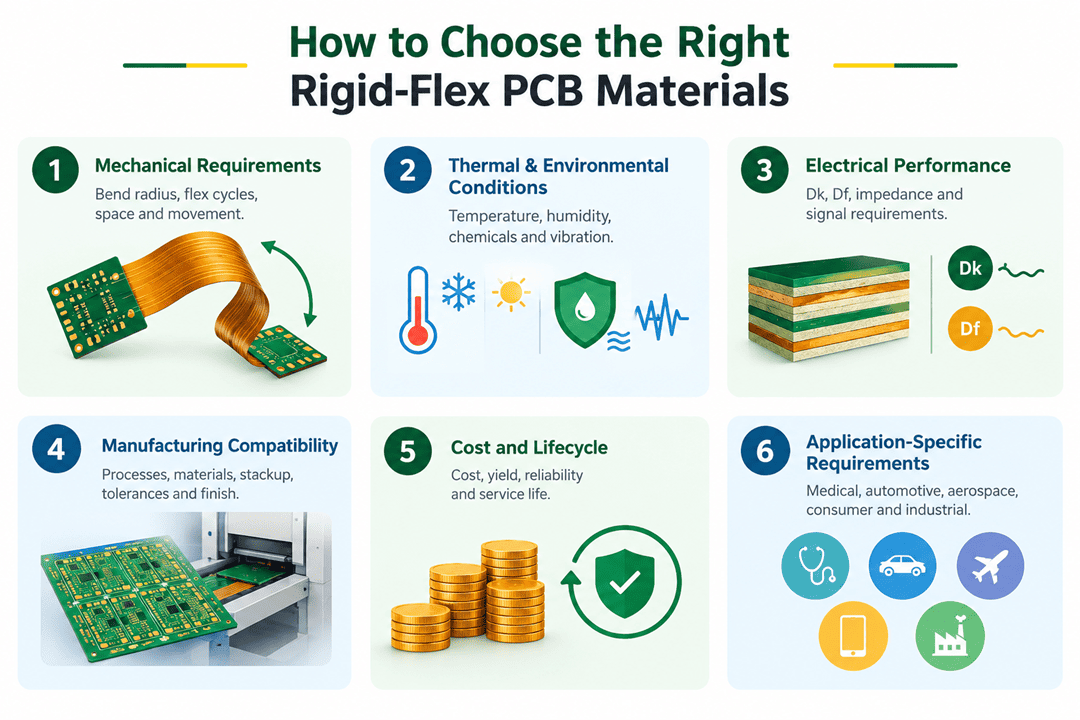
A practical rigid flex PCB material selection guide should evaluate the following factors:
- Mechanical Requirements: First determine how the flexible section will behave in service. Static applications have different material requirements from designs that undergo repeated dynamic movement. Bend radius, flex cycles, bending direction, and available space should be defined early.
- Thermal and Environmental Conditions: Evaluate the expected operating temperature and thermal cycling range to ensure the materials can maintain their mechanical and electrical properties throughout the intended service life. Moisture, chemicals, vibration, and other environmental conditions should also be considered where applicable.
- Electrical Performance: Dielectric properties become increasingly important in high-speed and high-frequency applications. Dk influences impedance, while Df relates to dielectric loss. Consider these properties together with dielectric thickness, copper geometry, and signal requirements.
- Manufacturing Compatibility: The selected material system must align with the fabricator's available processes and capabilities. Material availability, layer construction, copper thickness, coverlay requirements, stiffeners, tolerances, and surface finishes can all affect fabrication feasibility and yield. Involving the manufacturer early can help identify practical material combinations before design release.
- Cost and Lifecycle Requirements: Material cost should be evaluated alongside fabrication yield, expected service life, reliability, and application performance. Selecting the lowest-cost option may increase manufacturing complexity or create reliability risks if the material is not suited to the application.
- Application-specific Requirements: The final selection should reflect the priorities of the end product rather than relying on a standard material combination. Medical, automotive, aerospace, consumer, and industrial applications may have significantly different requirements for flexibility, thermal performance, reliability, and environmental resistance.
|
|
|
|
Build Your Rigid-flex PCB With Confidence
From material selection to stack-up and fabrication, every decision contributes to rigid-flex PCB performance.
Mega Plus PCB provides engineering support to help you select suitable materials, validate construction requirements, and prepare designs for reliable manufacturing. Send us your rigid-flex PCB requirements and let our team help you identify the right construction for your application.
Get a Quote
|
|
|
|
FAQs
Can rigid-flex PCB materials be customized for a specific application?
Yes. Material systems can be tailored to specific requirements such as flexibility, operating temperature, electrical performance, thickness, and space constraints.
Can the material selection be changed after PCB design is completed?
Yes, but late material changes can affect the stack-up, board thickness, impedance, manufacturability, and overall design performance. Material decisions are best finalized during the early design stage.
Should prototype and production rigid-flex PCBs use the same materials?
Whenever possible, prototypes should use the same material system as the intended production design. This helps ensure that testing and validation results accurately reflect real-world performance.
Can rigid-flex materials affect assembly processes?
Yes. Material properties can influence handling, soldering, component placement, and overall assembly reliability. Material selection should therefore consider both fabrication and assembly requirements.
|
|
|
|
|